


Labor Day Should Remind Us What Happened to Manliness
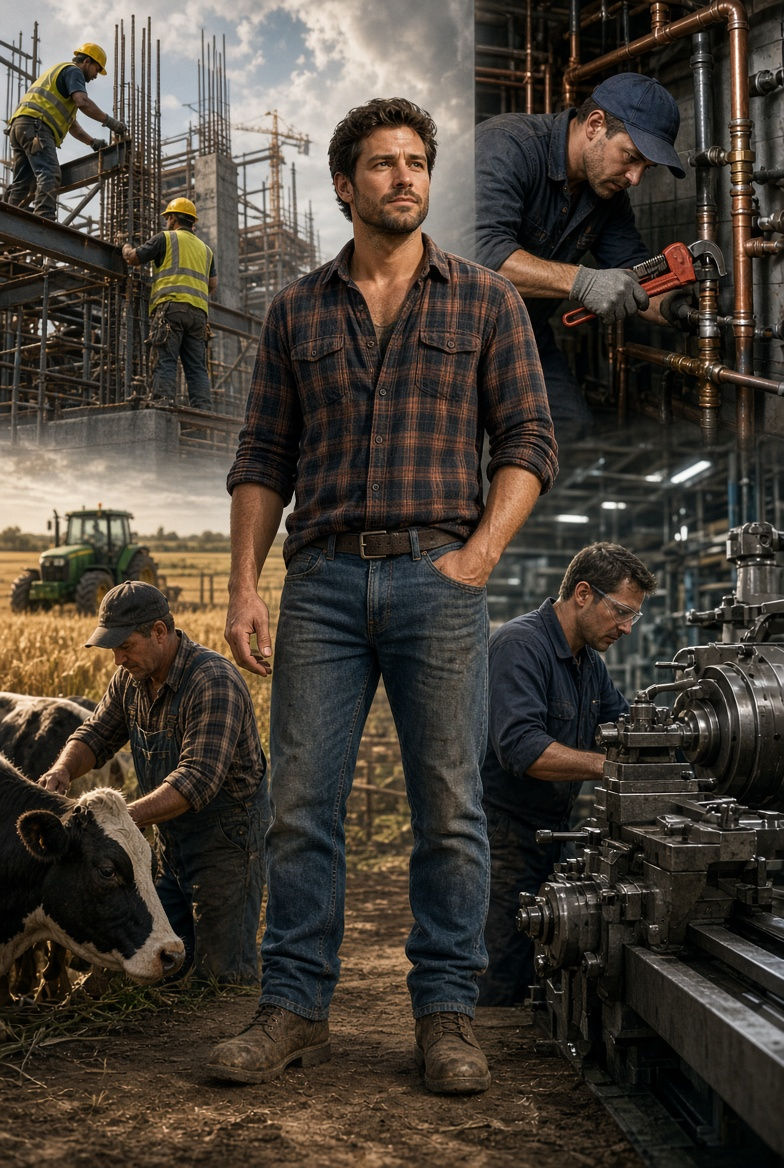
Even in these whitewashed times, somewhere under the crumbling trusses of our once patriarchal, male-chauvinist society, stinking like rotting corpses will, is the fact that from the beginning men have been judged by how reliably they bring home meat—and it’s mostly the women who’ve done the judging. In fact, it’s a safe assumption that before recorded time not coming back to the missus with a wooly mammoth rump roast, or at least a snared rabbit or two, wasn’t just tempting death by starvation, but an emasculating night at the cold end of the cave.
Indeed, no matter what today’s politically correct spin purports, at the end of the work day, a man is someone who can proudly answer the question, “What do you do?” And it doesn’t matter what he does as long as a man brings home enough meat, has pride in his work, and respects where his meat comes from. It’s this last condition that many of today’s men are uncertain about. This is because the process of literally earning our own meat, and thereby learning how nature truly functions, is a critical segment now largely missing from mans’ education. Tellingly, mans’ loss of a tangible role in nature is a recent phenomenon: In 1790, about 90 percent of Americans were farmers, but the percentage of Americans farming fell to 64% by 1850, to 38% by 1900, to 12% by 1950, and to about 2% of the American population today.
So, just two or three generations ago, more than one out of every 10 people in America still dealt with the wildlife that ate their crops, and with insects, droughts, and floods. And even those who didn’t farm in 1950, likely had a relative or a friend who did; as a result, they were still close enough to the natural process to understand how food was grown and what farmers had to do to control depredating wildlife and insects. But now, with just two out of every 100 Americans still tilling the land and six out of every 100 Americans hunting, we have in just the last few generations transitioned into a society that is so successful the bulk of the public doesn’t know where its food comes from—or has the slightest notion how to physically grow or kill their own. This is a staggering thing. The world has never seen this kind of society before. This is part of the reason why for the first time in history there is real antipathy and misunderstanding of manliness.
Theodore Roosevelt, a hunter, conservationist, and president, noted our waning connection to nature in 1899, when he wrote, “Over-sentimentality, over-softness, in fact washiness and mushiness are the great dangers of this age and of this people. Unless we keep the barbarian virtue, gaining the civilized ones will be of little avail.”
Roosevelt thought that, whatever the women are up to, men not accustomed to getting their fingernails bloody, or at least dirty, can hardly be expected to remain manly. Indeed this, more than any other factor, has softened men’s hands and feminized their behavior.
Just travel to any third-world country where men still have to till the earth with their hands and hunt to fill the pot, and look around and see if you can find a “girlyman” admiring his reflection in a stream like Narcissus and wishing he had a fuller-bodied shampoo. Such men don’t exist far off the pavement.
So, the domesticated man asks, does shooting a pheasant really give an understanding of nature? Not necessarily. But really studying pheasant hunting, learning where the birds move and feed and hide, is necessary to becoming a good hunter, and it’s those things that make a man knowledgeable. The reality is that being environmentally responsible is manly when it’s based rationally on science, not emotionally on nothing.


Comments