


What Do Women Want?

Jan Gossaert's "Adam and Eve" (1521)
Since Eve beguiled Adam men have been struggling to answer the question: “What do women want?” Today, however, men have largely concluded that the ancient feminine riddle is a paradox. Even that ultimate ladies man, Frank Sinatra, professed, “I’m supposed to have a Ph.D. on the subject of women. But the truth is I’ve flunked more often than not. I’m very fond of women; I admire them. But, like all men, I don’t understand them.” And the man who invented psychoanalysis, Sigmund Freud, opined, “The great question that has never been answered, and which I have not yet been able to answer, despite my thirty years of research into the feminine soul, is ‘what does a woman want?’”
Despite mans’ recent declaration of surrender, back in the 14th century Geoffrey Chaucer actually did a pretty good job of answering what women want.
“The Wife of Bath,” one of Chaucer’s Canterbury Tales, spins a yarn about a knight in King Arthur’s court. The knight, explains the wife, raped a woman and was subsequently caught. He would have been killed for the crime, but the queen interceded by asking the king to turn the knight over to her for judgment. The king complied and the queen gave the knight a year and a day to find out what women really want. She told him if his answer fails to satisfy her, she’ll have him executed. So the knight searches all over England for a year, but every woman he finds says something different. Some say women want riches, others flattery, some say beauty, others security . . . .
After a confusing year, the knight reluctantly heads back to see the queen all the while fretting that his head will be lopped off. But then he sees 24 dancers. As he watches them they suddenly disappear, leaving behind an old hag. The knight thinks what the hell, and asks the hag what women want. She says she’ll tell him if he promises to grant her one request at a time she chooses. He agrees and they go together to the castle. When they get there the hag whispers her answer to the knight, who then says that what women want most is “to have the sovereignty as well upon their husband as their love, and to have mastery their man above.” In other words, women want to be in charge.
The queen is as delighted as she is surprised by this perfect answer and so pardons the knight. But just when the knight’s jumping in the air and clicking his metal heels together, the hag cries out she saved the knight and her reward will be for him to marry her. He protests—a dashing knight can’t marry a hag, after all—but loses the argument when the queen makes him fulfill his promise. The marriage takes place the next day. But then, on their wedding night, the knight just can’t bring himself to consummate the deal—the hag is so ghastly he goes limp. So she sighs, okay, I’ll make you a deal, you can choose whether I’m ugly and faithful or beautiful and unfaithful.
He’s perplexed. On one hand she’d be revolting, on the other she’d force him to fight every knight in the castle, so after a lot of bellyaching he wimps out and begs her to decide. The hag then glows with delight because this capitulation to her will signifies the complete domination of her husband; as a result, she becomes both fair and faithful and lives with him happily ever after.
Now, Chaucer really doesn’t deserve credit for the revelation that women want men to concede defeat in the battle of the sexes; after all, the tale was simply a variation of the “Loathly Lady” story, a yarn popular in Chaucer’s day. But whatever its origin, the answer that women want to rule their men has since symbolically, if not literally, been realized. Just consider the evidence: Since the Middle Ages, Western men have been ritualistically conceding they want women to be in charge every time they fall on one knee to beg a woman to marry them. And, to woo women, men have long been required to blush with daises in their calloused hands, to procure boxes of candy on Valentine’s Day, to write love poetry, and to perform other rituals designed to temporarily effeminize their masculinity and thereby demonstrate they’ll do anything for a woman.
Which leads us to the root of the modern dilemma: when those chivalric rituals originated, the European feudal system was a comprehensible set of rules, because, after all, men wrote them to make women seem understandable. Men liked this societal arrangement because gentlemen could chase women, and then marry ladies (or at least tell themselves they were marrying ladies).
But then the whole snobbish, bigoted, sexist, class-structured charade came crashing down as middle-class societies crushed much of the class system in the 18th and 19th centuries and women’s suffrage struggles in the 20th century continued to stomp out sexism across the civilized world. As a result, modern societies are now as close to equal opportunity between the sexes as people have ever come, yet this positive change hasn’t made things simpler. This is because today’s women still cling to most of the tenets of the old chivalric ideal, a code that requires men to treat women as ladies. Women adore chivalry even though feminists often deem it to be sexist because condemning male chauvinism while cherishing chivalry allows them to have it both ways: They get men who are required to open the door for them yet who must consider them equal in all ways.
Women, you see, still want the fairytale of the valiant knight in shining armor freeing them from a stultifying life of waving hankies from a tower. And they want it even as they compete with men in the workplace. Though women want the dashing knight or the cowboy in the white hat, they understandably would rather not have that recently dead patriarchal system’s sexism, male chauvinism, lack of rights.... This, naturally, is confusing to men who often want something equally difficult to find, as Edward Dahlbert crassly explained: “What men desire is a virgin who is a whore.”
These competing—albeit overly simplified—points of view show why today’s men have given up uncovering what women want. And it’s why men now shrug as women declare they want to be both ladies and women at the same time (and sometimes even men). This is why back in 1933 Compton Mackenzie wrote, “Women do not find it difficult nowadays to behave like men, but they often find it extremely difficult to behave like gentlemen.”
Indeed, women now have membership into every segment of a “man’s world” but don’t always have to adhere to mans’ chivalric code.
So, given this rigged arrangement, how does a man navigate today’s feminist minefield and come out the other side with some working notion of what women want? First realize that the modern spin on the Wife of Bath’s tale is that what women want are men who are strong, yet supple to their wills—even when their wills are whimsical. Women want to be in charge, except when a spider crawls up the wall, there is a bump in the night, or a calamity strikes—though they may or may not want to take charge then, as well. So to be an old-fashioned romantic with a modern sense of equality, first, as Sigmund Freud advised, gird your loins with the realization that “a woman should soften but not weaken a man.” Next, as stupendous as this notion at first seems, come to understand that women don’t see any contradictions in their viewpoint. To women it seems reasonable that they don’t want their men to be shallow, yet they want their men to tell them they’re beautiful at all times, even though a man can’t possibly tell a woman she’s beautiful without being superficial.
So to navigate such dilemmas, men need to embrace the idea that the only concrete thing we can say about romanticism is that’s the affirmation of what a man is fighting for; that it’s the acknowledgement of a heart. And without a heart a man becomes the Tin Man wandering the Land of Oz, a hollow man with brains and bravado, but no human compassion. This is why every male icon from Ancient Greece’s Odysseus to the Middle Age’s Roland to the American West’s Wyatt Earp to contemporary heroes like James Bond and Superman have been romantics. And why every Hollywood action hero is a cliché without humanizing scenes such as when Martin Riggs cries at the grave of his dead wife. So the lesson here is that men shouldn’t fret too much if they don’t know what woman wants; instead they should just know that a man who isn’t a romantic isn’t a complete man; he’s, at best, the Terminator, a brawny, courageous, heartless machine.
So be a romantic by, as much as you can, becoming the strength behind her will. And when you’re wrong—and you will be—reaffirm their power over your heart with an honest romantic gesture.
Treat Every Woman as a Lady
“I don’t think there will be a woman prime minister in my lifetime.” –Margaret Thatcher, on the BBC in 1973
“I think male Prime Ministers one day will come back into fashion.” –Margaret Thatcher on TV-AM in 1988 after having been prime minister of the United Kingdom for almost a decade
Office romances are notoriously tricky—even when both parties do their best to keep things professional, quiet, and low-key. I knew one apparently star-crossed couple—I’ll call them Mark and Mary— who tried to do everything right, but one of them got the other fired.
She was new in the office, just out of grad school. All the guys noticed her. If they didn’t, they should have. She wasn’t a Marylin Monroe broadcasting a look-at-me sex appeal with flirtatious glances and a walk that made men stop. She was appropriate in the office on New York’s Park Avenue. She just couldn’t help her looks and how they made men feel in the Manhattan office.
He was two years older, and in a different department. They took pains to avoid gossip, even leaving separately and meeting at out of the way restaurants for lunch where they wouldn’t be seen.
But he still got fired.
I was there the morning they let him go. He had packed up his belongings in a box, and looked bewildered. I followed him outside and we went to a coffee shop. He started to tell me about Mary.
The day before, she had passed him in the hallway. They did not acknowledge each other. In fact, Mark was talking to a colleague, but the colleague turned and nodded at Mary’s departing figure and whispered, “You hittin’ that?” Mark didn’t know how to respond, so he just smiled and walked away. But a woman in a nearby cubicle overhead the crass colleague, and passed the news to Mary.
Mary fretted all afternoon and finally left the office early feeling sick. She met Mark that evening and confronted him. She was scared her career would be derailed by gossip and that she would be made out as the office harlot. Someone told her that he had another office romance in his past, and that woman had left. Did this sort of gossip drive her away? Mark tried to reassure her. He said that yes, he had gone out with another woman in the office, but that had nothing to do with her departure—she had been offered a better position downtown—and that it hadn’t been much of a relationship anyway, though they were still friends. Mary didn’t find that comforting—in fact, she worried about his motives. She reminded him that she had not encouraged his advances—and in fact had deterred them initially. But he had been boyishly persistent and she had finally consented to go out with him as long as he kept it quiet. Now she worried that he was using her—regarding her as an affair, something he could brag about, to score points with men at the office. It made her feel defiled—and his denials didn’t help. She thought it was damning that he hadn’t confronted his crass colleague, hadn’t told him to grow up, hadn’t defended her honor.
That morning she went to human resources. She later said she didn’t want Mark fired; she just wanted to know her options. But the company moved immediately to protect itself from any potential lawsuit for sexual harassment by dismissing Mark.
“Look, I know there are monsters out there,” Mark said, glancing at the glass high-rises outside the coffee shop. “But I’m not one of them. I’m still nuts about her. Well, I don’t know how I feel now. She did this to me. All I did was fall for her and she got me terminated. Maybe I should just forget about her. Maybe she’s poison.”
They laugh about it now.
They are married and live in a Midwestern city and have two kids and good careers, though for different companies.
“This wasn’t some #MeToo thing,” she says. “I guess I just didn’t know what would happen. I didn’t understand how things are. How could I? How can anyone? Things are changing so fast. And they need to, I mean, there are some very bad guys out there. But there needs to be commonsense, too. We need rules, a process that’s fair that protects the vulnerable and that doesn’t just punish men by default.”
In the end, Mark handled the situation relatively well. He kept his head. He was polite to the head of human resources. And obviously the story had a happy ending. But it also highlights how fraught the office environment has become between men and women.
The modern gentleman knows there’s a big difference between chivalry and sexism. Mark’s crass colleague was sexist in making a crude remark. Chivalry, on the other hand, is about treating women with deference and respect. Chivalry is also about self-control, upholding what’s right, and defending other people, including women. If Mark had defended Mary by telling his colleague to grow up, he might have saved himself a lot of trouble, and put office gossips in their place.
There is nothing wrong—and everything right—with holding a door open for a woman, or letting her onto the elevator first, or offering her your coat on a cold night or your umbrella when it’s raining, or extending any of the other simple courtesies that men used to routinely extend to women, and that made the interactions between men and women a little more pleasant and cordial and kind. I only once had a woman get mad at me for opening a door for her. It was in Manhattan, and she was young and pretty and getting too much attention from guys on the staff. She said, “I can open doors for myself.” I smiled and said, “I’ll remember that.” Months later she apologized. By then she’d become engaged to one of the men in the office, she no longer felt threatened by all the male attention, and she realized that not all of us were wolves.
Lieutenant General Robert Baden-Powell, who created the Boy Scouts, came up with the rule that a scout is clean in thought, word, and deed. However old-fashioned it sounds, there’s no better advice for a man in the modern office. And you can update it by adding: “The man in the office is clean in thought, word, and deed—and well aware that his intentions might still be misconstrued, and so must be even more careful.”

Grace Kelly

Jean Simmons

Lauren Bacall

Marilyn Monroe
Does the “Mike Pence Rule” Make Sense?
Many in the mainstream media mocked, or even vilified, former Vice President Mike Pence for abiding by the rule of never having dinner alone with a woman other than his wife. But in the #MeToo era is that really such a bad rule?
Sheryl Sandberg, then the CEO of Facebook, said it was. “In the aftermath of #MeToo, as several powerful men have lost their jobs (good!) for harassing women, some men have chosen to react by adopting what’s called the Mike Pence rule—never having dinner alone with a woman other than your wife,” she wrote. “If men think that the way to address workplace sexual harassment is to avoid one-on-one time with female colleagues—including meetings, coffee breaks, and all the interactions that help us work together effectively—it will be a huge setback for women.”
Needless to say, that can be true, but nevertheless, men in today’s workplace should be very cautious of being alone with a woman in the office or in social settings, especially when alcohol is present. A misconstrued word or gesture could lead to an accusation of sexual harassment.
In a climate where men are considered guilty before perhaps being proved innocent, this Pence Rule is rational, as one misunderstanding can end a career.
“As for the Pence rule—if you insist on following it, adopt a revised version,” said Sandberg. “Don’t want to have dinner alone with a female colleague? Fine. But make access equal: no dinners alone with anyone. Breakfast or lunches for all. Or group dinners only, nothing one-on-one. Whatever you choose, treat women and men equally.”
Anyone who has ever travelled for business knows it’s rarely that simple. It is often necessary for business teams to be broken up at trade shows, sales calls, off-site meetings, and so on.
Sandberg also avoided addressing a truth so old it is in the Old Testament. In “Proverbs” we read the warning that “the lips of the adulterous woman drip honey; and her speech is smoother than oil; but in the end she is bitter as gall, sharp as a double-edged sword.” If a man does mentor a woman and, at some point, she pursues him to have an affair, what happens if he rebukes her advances? Will she turn on him out of anger or embarrassment, and accuse him of harassment, of leading her on? If he is innocent and denies her accusations, what are the chances that he’ll be believed? What business, to avoid liability, wouldn’t fire him first and ask question later?
In a corporate setting, in-house attorneys are often brought in to manage away any serious situation; sometimes by settling with the accuser and getting her to sign a nondisclosure agreement. The risk of having to pay such cash settlements is another factor driving male managers away from mentoring female employees. But it also cuts the other way: sometimes non-disclosure agreements protect people who are guilty of vile conduct.
In the corporate world, forced arbitration agreements are used to keep claims out of court—and so out of the public eye.
So, in the light of all this financial and legal risk, the Mike Pence rule is a sensible precaution in the workplace of today. The best way to avoid trouble, after all, is to avoid situations where there could be any doubt.

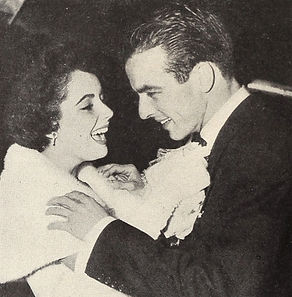
Montgomery Clift has his tie fixed by Elizabeth Taylor
Montgomery Clift is at a dinner scene with Stazione Termini
How to Defend Women (and Men) in this Age of the Hashtag
Joseph Campbell, a famed professor of myth, once said that the trick for a married couple to keep a long and lasting relationship is for them to successfully shift from “passion to compassion.” It seems that our culture needs to do the same.
We begin by exerting self-control. Though stoicism is often misunderstood by the mainstream today, a gentleman learns to be stoic so he can control himself when we need him most, such as in a crisis or when a truly bad dude is in the office; a gentleman toughens himself by tackling real things in life; a gentleman, by definition, endeavors to be a well-rounded man who helps and defends women.
At the same time any reasonable man realizes that equal rights between the sexes are an ideal in law and practice that has yet to be fully realized in the workplace or society, and that maybe it never completely will be attained, as men and women are different and all of us are fallible. Still, the ideal is lofty and good nonetheless.
Actually, the basic truth that all people have the same rights in their political, economic, and social lives is thousands of years overdue. The fact that we are all equal before God, and therefore in rights, is a basic Judea-Christian principle that once challenged the “divine right” of kings and empowered English juries to judge as they saw fit. The idea that every person is equal in rights to every other person spread over the Atlantic and gave the world the wildly successful American experiment. This basic and beautiful concept flowered in America and has, over the past two centuries in America, grown at least in principle to include everyone, no matter their race or gender, and that’s a beautiful thing.
Surely the popularity of Jordan Peterson with young men is a step in the right direction. Consider this passage from his massive bestseller 12 Rules for Life: An Antidote to Chaos: “Aim high. Set your sights on the betterment of Being. Align yourself, in your soul, with Truth and the Highest Good. There is habitable order to establish and beauty to bring into existence. There is evil to overcome, suffering to ameliorate, and yourself to better.” This is another call to chivalry. And the more we can get back to the ideals of the gentleman, the better off our society will be for men and women. As one woman on Wall Street told me, “I’m tired of dating weak metro men. They’re boys—forever weak and juvenile and so afraid to offend. They make me nervous, because when they do break the bounds, like children they don’t know how to control themselves—they seem to have none of a gentleman’s strength. I want a man—a strong gentleman.”
A gentleman’s strength comes from his character—and when it comes to improving our national character, men and women both have a role to play. I graduated from a military college with women as fellow cadets. I’ve run with the bulls in Pamplona alongside men and women. I’ve hunted dangerous game with men and women. I’ve spelunked into caverns and climbed cliffs with men and women. Along the way I’ve found that some of the most courageous and honorable people doing these things with me were women. I’ve also met and interviewed many fine police officers, U.S. Marines, and fire fighters, and know that some of the best among them are women. Strong character is something that can unite us, whatever our chromosomes. The goal of each and every one of us should be to be stand-up, strong, compassionate, courageous, and honorable individuals.

Barbara Stanwyck

Joan Crawford
The Well-Thought-Out Entrance
Women think about their entrances much more than men typically do. Women often think about how they walk, about their posture, about the movement of their hands, about how they’ll sit (both feet on the floor or legs crossed).
Men often just stupidly stumble in and figure they can handle it—whatever it is, a business meeting or a date. This approach has its merits, as it can broadcast simple, unscripted confidence. It also has its downsides, as it can leave a man unprepared for the scene in which he needs to play a starring role.
The best way to create a good entrance is to visualize the place you’ll be—an office, a restaurant—and you in the scene. See yourself moving confidently with your shoulders back, a strong stride, and a confident smile on your face. Once you’ve established yourself, be aware of your surroundings, whoever it is you’re talking to, and be prepared to listen and respond thoughtfully.
Here are the fundamentals for different situations.
-
The Pickup: The big mistake is the too-practiced line, or lines, which you’ll forget or stumble over in the heat of the moment, and not listening. Stay calm, make eye contact, and when you introduce yourself don’t stand too close, so that you don’t appear too eager or intimidating. Listen and respond, with light humor if possible. If she doesn’t seem interested in talking with you, politely move on.
-
The Date: She is there to see you. So enter confidently, but take yourself lightly. Turn the conversation to her, let her know you’re interested in what she thinks, but don’t interrogate her. She’ll tell you—in her words or in her manner—if she’s interested in another date.
-
The Interview: You need to look the part—again, if the part is not you, you are in the wrong interview. Be clean and on time, courteous and confident. Don’t lie, not about anything. I once didn’t get a job because I lied about something that I thought didn’t matter. I interviewed for a summer position while I was in college, and the interviewer asked if I had another job. I said, “No,” because I wanted the interviewer to know I was wide-open to doing whatever needed to be done on this job. But I found out later that he already knew about the other job, and passed me over because he felt he couldn’t trust me. That taught me an important lesson: always, always, tell the truth, even about things that seem trivial. That does not mean, of course, that you treat an interview as a confessional. Just be honest and truthful. The best defense is to live your life prudently, honorably, and well.
-
Shake hands when you enter— grip the other person’s hand firmly, shake it once, maintain eye contact, and smile; that’s it—and then sit with your back straight. Make sure your cellphone is switched to silent mode. Fill any awkward pauses with compliments about the office or the potential employer.
-
The Business Meeting: Other than your appearance and entrance, realize this isn’t all about you. You are there to forge a transaction that will be mutually beneficial; the best salesmen knows he is there to help his potential client. Focus on service; money can come later.
One businessman I know who owns an import/export company won’t even talk money in a business meeting. He waits until he’s at the airport. He makes great deals because he concentrates on building a relationship and providing great service. Maybe even more important, he is incorruptible. He has turned down countless illicit payoffs, which has built him a sterling reputation for integrity and won him enormous trust from his clients.

Statue of Cary Grant
The 10 Greatest Quotes on Women
-
“It upsets women to be, or not to be, stared at hungrily.” –Mignon McLaughlin
-
“I have great hopes that we shall love each other all our lives as much as if we had never married at all.” –Lord Byron
-
“A pessimist is a man who thinks all women are bad. An optimist is a man who hopes they are.” –Chauncey Mitchell Depew
-
“Whether they give or refuse, it delights women just the same to have been asked.” –Ovid
-
“Ah, women. They make the highs higher and the lows more frequent.” –Friedrich Wilhelm Nietzsche
-
“One should never strike a woman; not even with a flower.” –Hindu proverb
-
“Do you not know I am a woman? When I think, I must speak.” –William Shakespeare
-
“You should never say anything to a woman that even remotely suggests that you think she’s pregnant unless you can see an actual baby emerging from her at that moment.” –Dave Barry
-
“You treat a lady like a dame, and a dame like a lady.” –Frank Sinatra
-
“When the candles are out, all women are fair.” -Plutarch
.jpg)
Frank Sinatra