


Why Men Dream of Hunting Cape Buffalo
- frankminiter
- Jan 29
- 10 min read
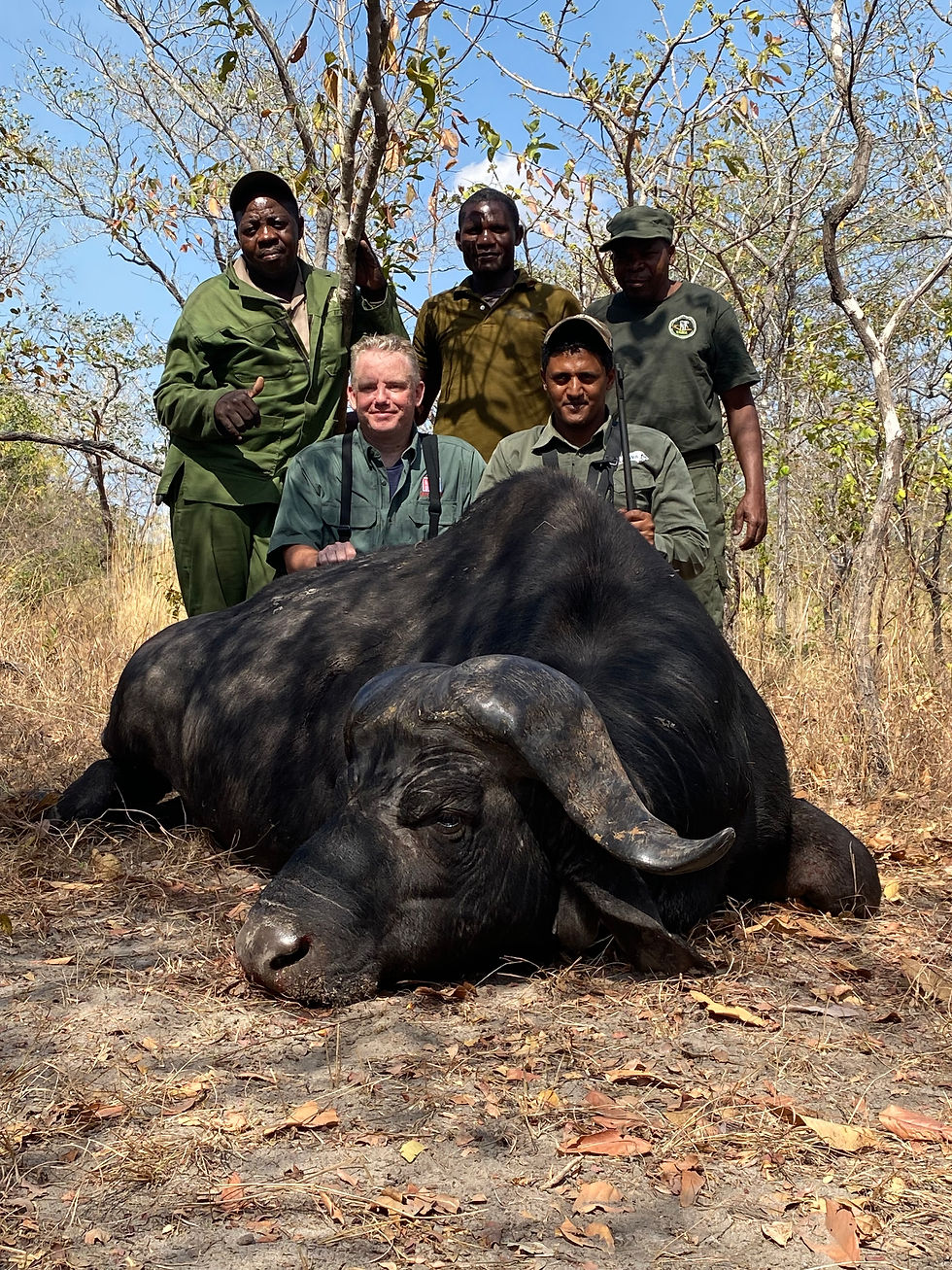
This is an adventure that began at the Big Game Dinner last year. My guest was Frank Zitz. He is a taxidermist (taxidermymuseum.com). If you’ve been to any Cabela’s store or to Johnny Morris’ Wonders of Wildlife in Springfield, Mo., you’ve seen his work. As he knows more about the world’s big game than anyone I know, I casually asked him about all the game in new building. He went around the room and when he got to the Cape buffalo on the west wall, he said, “I’ve never had one big in my scope.”
“Can you even find them like that anymore?” I asked.
“Yes, but takes just the right combination of—” he paused as his mind wandered around southern Africa. When he had looked over the many countries in his mind, he asked me, “You interested?”
I smiled and about six months later, in late July, I was looking over Cape buffalo tracks sharply cut into a white sand road. Frank Z. had found a new concession in Tanzania’s Selous that was said to have some giants. The trip turned out to be one great adventure wrapped in a series of misadventures, but we were in the bush and anything can happen in the bush.
A tracker was kneeling over the tracks. He turned his face to me and said, “Dagga boys.”
My eyes followed the tracks across the sand road in the bright morning light and into trees, waist-high brown grass and dry fallen leaves. I knew that at the end of those tracks were 2,000-pound buffalo.
To me, these tracks are Tanzania’s Selous condensed to sign left in sand, as they were big, were pushed into the earth by a dangerous-game animal, and were loaded with uncertainty.
Yet, they also seemed as simple as the opening pages of a classic African novel presenting itself page by page or, in this case, track by track. As a writer, what surprised me was that following these tracks, as we had done for seven days at this point, felt more William Faulkner than Ernest Hemingway to me. Faulkner took us into the surreal quality of a forest and its wildlife (he does this so well in Big Woods); whereas Hemingway loved the inner drama of the inevitable tragedy of man (such as in The Snows of Kilimanjaro). Hemingway was always trying to make the mysterious understandable (as he did in Death in the Afternoon). Faulkner, though hardly known for African adventures, never tried to make the mysterious sensible; instead, he used his lyrical words to tiptoe into the mysteries of the forest and the inner self, as if dusk is forever deepening into darkness around us. At first taste, that was Tanzania’s Selous to me. To turn this into a Hemingway tale, the buffalo would have to charge.
That possibility was about to present itself, but right at this moment those two author’s perspectives seemed to meet in this reality of tracking Cape buffalo, because, though doing this kind of hunt is as simple as following big hoofprints in the sand, it is nevertheless fraught with the unknown of what might happen when we do meet what is at the end of a track. Indeed, to be ready for the buffalo it is necessary to push away the imagination and to stay in the moment, as Hemingway would have advised.
What also surprised me, is none of this was Robert Ruark to me even though his classics (Horn of the Hunter and, especially, Something of Value) gave me, as a teen, the basis of my worldview of this wild, romantic and complicated part of Africa. On this trip, I found that Ruark’s Africa is past, as the aftershocks of colonialism have long since grown into other things.
But then, it can still be wild. I had one reminder of this when I heard the story of one of the men serving us in MKwala Hunting Safaris’ lovely bush camp. His name is David. He is a small man with a very polite smile and quiet way. But one night some years ago, after he’d helped dig a pit to catch a hyena that had been raiding the camp, he forgot the pit was there when he went out to pee. Like in a cartoon, they’d put sticks and leaves over the hole and baited it with dried meat. When David stumbled out to relieve himself, he fell into the pit. The thing was the hyena was already there. He screamed. The hyena made its cacophony of sounds. No one came to help. The hyena used its muscular jaws to push its canines into David’s arm, chest, and head, but David managed to get on the hyena’s back and to get it in a choke hold. They battled like this for an hour before David choked the spotted hyena to death. David bashfully showed me his scars while he poured me a drink.
I was brought out of these reveries when Jamin Jamal (jamil.jamal@yahoo.com), my PH with MKwawa, waved a hand at the tracks. Jamil was 40 years old on this very day and had a double rifle in .500 Nitro Express over his shoulder with the barrels in his left hand. “Come. We’ll follow these two bulls. The tracks are fresh,” he said.
We entered the forest as we had for days; that is to say, quietly and with controlled expectation. There was waist-high tan grass, dried leaves in late July (winter in the southern hemisphere), and trees spaced out by mostly 10 or 20 feet. The ground was sandy and hard an inch down. The forest grew thick ahead, but we knew it would open into long grass here and there and that the bulls would graze before they bedded in the heat of the day.
Jamin is a Tanzanian of four generations. He has young children, an easy humor, and has stopped buffalo charges with his .500. He directs his trackers in Swahili and helps them on the track if they get stuck. When they find a track, they’ll point with a short stick taken from the ground and whistle lightly.
They stopped and Jamin signaled them with a wave of his hand to fan out. The bulls had been grazing here and the trackers needed to find where the tracks left the area.
I leaned my rifle against a large tree and watched them. I didn’t want to get in their way or to step on the tracks in the leaves and grass and so I watched as I had been doing all week. I looked down at my rifle and I was no longer angry about what happened. I had a beautiful Mossberg Patriot in .375 Ruger when I arrived at JFK to fly on Air Emirates. We hired a travel agent who specializes in booking flights and taking care of other details for travelling hunters, but though this agent has decades of experience, he didn’t know Emirates requires guns to be checked in two days before departure. In short, we were told there was no way they would let us on the plane with our rifles.
Frantic phone calls were made and soon our guns were sent home by the driver who’d taken us to the airport and our outfitter for this adventure (Link’s Wild Safaris; linkswildsafaris.com) assured us they had rifles in Africa we could borrow. But I had practiced with the Mossberg on our 100-yard range. It can shoot. It is comfortable to carry. It grouped three-shot groups into an inch and a tenth at 100 yards with Hornady’s .375 Ruger DGX Bonded Bullet in 300 grains. Going into the bush for Cape buffalo is picking a fight with a dangerous game animal. You want to be sure of your rifle in such a situation. No rifleman wants to go afield without a known and trusted friend in a gun, yet here I was doing it.
The outfitter did have Hornady DGS 300-grain ammunition in .375 H&H. And he had two very old Model 700s for us. One topped with a Zeiss from maybe the 1980s and the other with a Leupold that was just as old. The rifles shot three-inch groups for us off a truck’s hood at 100 yards. I told the PH I didn’t want to take a longer shot than 100 yards on buffalo with these rifles and he said that would not be a problem.
A tracker whistled and we were off again following the tracks of the two bulls. They meandered into a thorn thicket and I remembered two bulls from the day before. We didn’t see them until they were 12 yards from us. Even then there was no shot. Only horns moving in the thorn brush and then huge black bodies going away.
A tracker knelt down and pushed a finger into a pile of buffalo dung. “Warm,” he whispered.
We were stepping carefully now, but for a few minutes it wasn’t necessary to be silent, as a group of bush pigs came close. Their many quick-moving feet sounded like crinkling newspaper in the dry leaves. I watched them and smiled. We saw so much on this trip into the Selous. Wildebeest, impala, zebra, eland, hippo in the waterholes, warthog, impala, kudu, elephant, baboons … even a leopard in the headlights. We didn’t see the lions, but their tracks were in the sand of the roads and we heard them roaring at night.
This is a new concession for Jamin and MKwawa. Their old concession, along a river, was so well maintained and protected by them that the Tanzanian government decided to make it a national park. This other concession was leased to them in recompense. In just a year, without their protection, Jamin told me that 95% of the elephants and so much more game had been poached out of their old area.
“We had 27 trucks patrolling that property,” said Jamin. “But now, game rangers have one truck that always seems to be out of fuel. This is Africa. Hunters are these animals’ best defense.”
Still, they were excited about this new concession. It had not been hunted in years. During the hunt we did find evidence of a poacher who’d killed and dried the meat of a zebra. But Jamin assured us they have that under control.
When they temporarily lost the track again, I waited in thick brush alongside an opening of maybe 10 acres. I could see impala feeding out in it. Before long Jamin softly whistled and the trackers came close and moved leaves with their sticks. They spotted the tracks again.
This reminded me of a track we followed a few days before and of four bulls we slipped to within 30 yards of. The bulls looked big to me, but Jamin assured me they were all a little small and then a herd of impala winded us and went running through and the buffalo stampeded away. When the bulls ran, they sounded to me just like the bulls do when they come down those canyons of streets in Pamplona.
One of the trackers suddenly knelt down and pointed. He turned to look at me and nodded and his lips parted into a broad smile. “Dagga boys,” he whispered.
Jamin and I stayed low as we tried to slip in like leopards. At 60 yards we stopped. We could see a bull bedded. We could see his black back, his nose and his heavy bosses.
“He is an old bull,” said Jamin, “but I cannot see how wide he is.”
This was day eight and I loved this hunt and this then three-hour trek along these bull’s tracks. The bull was an old and I had never shot a Cape buffalo. Old and with character are all I hoped for. I slowly went onto the sticks. I knew I would have to wait until this bull stood. I expected to have to wait a long time, but then the bull was up. The late-morning winds were swirling. These bulls don’t always trust their eyes, but they trust their noses. I have passed on other shots this week, as they were not ideal. This time I saw the bull’s shoulder as he stepped into a three-foot window in the dense bush and I shot.
We then see two bulls—or parts of them—disappear into the bush. We take a breath. I reload my rifle. And we follow.
The ground opened up and we saw blood in the grass. Though I don’t know it, one of the trackers is using Jamin’s phone to record the hunt from behind. This next sequence of events takes about 5 minutes, though it felt like 30 seconds.
The bull I shot was lying down with his head up. We couldn’t see his body. The other bull was standing nearby. This bull knew we were there. He was pacing, but he didn’t want to leave his old pal.
We circled to find a clear shot from about 80 yards. Just as we get there, the mortally hit bull leapt to its feet and turned to us. He was moving his head from side to side to find us so he could charge.
“Shoot,” hisses Jamin and I already am.
At the shot the bull turned and ran. I shoot again and the bull slammed into the ground with a broken hip. I reloaded and ran to a better position. I put two more shots into the bull’s shoulder. The bull was down and was moaning.
In seconds it is over. The bull probably once had big, sweeping horns, but one side had since been broken from the head of this 15-year-old warrior and the other was rubbed short. So no, he is not the trophy that is on the wall in Campfire, not if you go by score, but he is wild and big and lived a long life here with lions and in the big herds and with other dagga boys. His left ear was ripped to the base from some long-ago battle. Scars were all over his face. He is perfect.
“He was about to charge,” said Jamin with a laugh in this voice as he put down his double rifle. “He was looking for us. Your shot convinced him to run instead.”
“I wish he had,” I said and I meant it. I want this animal, above anything else I have hunted, to have and to keep its dignity. Hemingway wrote in The Garden of Eden that after we kill the only dignity an animal has left is what we give it. I think that is true and I was pleased to see Jamin, the trackers and the game ranger there with us gave the buffalo, this hunt and this place the respect it demanded.


Comments